Analysis · Iowa
The Panel has Ruled on the Issues in LP Iowa
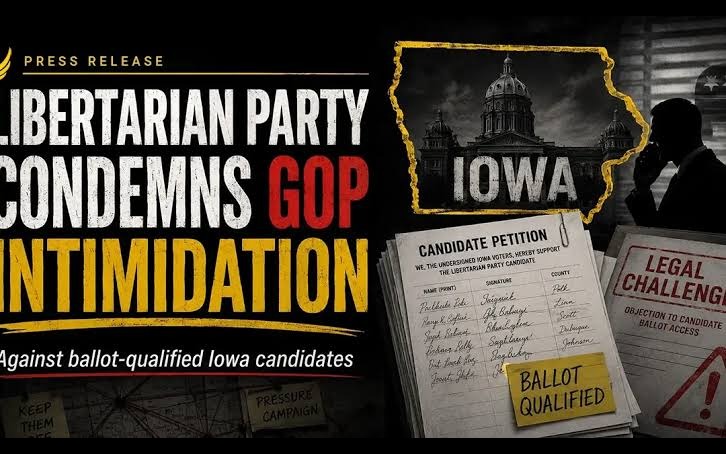
When we last wrote about the Libertarian Party of Iowa, the Republican challenges were freshly filed, and was set to be decided on June 15. If you were hoping the hearing would clarify matters, we have bad news. Nothing about it is as tidy as either side wants you to believe.
The three-member panel consisting of Secretary of State Paul Pate, Attorney General Brenna Bird, and Auditor Rob Sand took two of the three challenged Libertarians off the November ballot. Marco Battaglia (3rd Congressional District), Nicholas Gluba (gubernatorial candidate) and running mate Jules Cutler have been removed from their races. Rick Stewart (2nd Congressional District) survived his challenge and will be on the ballot.
Issue #1: Two Different Name Standards
Rick Stewart filed as "Rick" when his legal name is "Richard." The panel waved it through. Pate said it's "very common for candidates to run using shortened versions of their names." This is completely reasonable. Nicknames are acceptable under Iowa law.
Marco Battaglia filed under the name he's used for his band, his podcast, and three previous Iowa ballots, but his legal name is Mark Thomas Andersen. Unlike Rick, the panel removed him. Pate's stated test was whether a name is "sufficiently associated with a candidate that a potential voter would not be confused." By that test, you would think that a guy who's appeared on the ballot three times as Marco Battaglia would seem to pass easily.
So "Rick for Richard" is a permissible nickname, but "Marco Battaglia", with a decade-plus paper trail is unacceptable? Bird's reasoning was that Iowa Code requires the name be "in the form of the candidate's name, not someone else's name." That's a defensible reading of the statute, but it isn't consistent when you've just blessed "Rick" minutes earlier.
Auditor Rob Sand, the lone Democrat sitting on the panel, voted to keep Battaglia on, arguing that forcing "Mark Andersen" onto the ballot would create more voter confusion. He floated an estoppel argument, the idea that the state can't suddenly object to a name it has accepted on the ballot in prior elections. LP Iowa Chair Stephanie Berlin jumped on it, pointing to Rep. Ashley Hinson, whose legal surname is now "Arenholz."
A 2-1 party-line split on the most contested call in the hearing is not a ruling that's supposed to be about neutral paperwork compliance. Whether it survives a court challenge is a genuinely open question. The Battaglia removal is the most legally vulnerable piece of the whole thing.
Issue #2: Whose Memory do you Trust?
This one isn't about statutory interpretation of the law. The objection was that Cutler never filed her affidavit of candidacy. Because Iowa requires a complete ticket, this also affects Gluba. Cutler says she tried to file it on June 2 and was told by elections staffer Dani Phillips that she didn't need to. Phillips testified she never received an affidavit from Cutler and was never asked whether one was required. So who's right? The panel sided with Phillips. Bird's logic: "I tend to side with the election worker, because I don't think she has a reason not to follow the law."
Cutler's attorney, Jacob Heard, told the panel Phillips actively declined to accept the affidavit in front of witnesses, including Gluba. Cutler pointed out that Phillips couldn't remember specific details like whether Cutler was even present, who prepared the affidavit, or her own commission date. Yet, the panel accepted Phillips' recollection on the one fact that mattered. Cutler also said she requested the lobby camera footage from June 2. This would have shown whether she was there, but the request was ignored.
A district court reviewing the record fresh could land somewhere different, especially if that footage surfaces to confirm her recollection of events. Cutler said it was the most disheartening experience she'd had since immigrating from the Soviet Union at sixteen.
Issue #3: The Kennedy Element
Battaglia says HHS Secretary Robert F. Kenedy Jr., now HHS Secretary, called him on June 8 and pushed him to drop out. He says he answered an unknown number expecting a debt collector and instead heard, "Hello, Marco, this is Bobby. Bobby Kennedy." He says Kennedy told him that if the seat flips, "it'll make my life hell." According to Politico's reporting, Battaglia showed a reporter screenshots of his call log showing an incoming call from a number Kennedy has previously used, though those images have not been published anywhere publicly viewable. Kennedy's office has not responded to any requests for comments. No one on Kennedy's team has confirmed or denied the call.
The Hill noted the White House has been deploying Kennedy across competitive House districts as a midterm surrogate. So we have a firsthand account from Battaglia, reporter-described call-log screenshots, and a pattern of Kennedy showing up in swing races. That's meaningfully more than loose correlation, but is not the same as confirmed fact.
Here's where it gets more complicated. The LNC has framed the Kennedy contact and the legal challenges as one unified operation. They may be right, but (at least from the current public view) those are actually two separate things, and the evidence doesn't currently tie them together in any meaningful way.
Nunn's house visit with the alleged "we'll fly you to D.C. and make you my wingman" offer, and the Kennedy call involves no paperwork, no filings, and no confirmed coordination between the participants. The formal ballot objections filed by Nunn operatives Annie Kuhle and Wes Enos is a separate action, run through proper channels, with named parties.
A Nunn campaign official told the Register they kept "outside stakeholders, including the White House," informed of their signature concerns, but insisted they never asked anyone to act and didn't know about Kennedy's call until Battaglia told them. Kuhle says her meeting with Battaglia was strictly about investigating potentially fraudulent signatures. Their account thus far describes two parallel efforts pointing the same direction rather than an orchestrated operation.
According to reporting from Little Village, the screenshots show Battaglia offering to consider dropping out if Nunn would introduce articles of impeachment against the President. Kuhle's reply, as reported: "to be clear this is not a negotiation; Zach will not be making any promises about official policy actions in exchange for your removal from the ballot." Following the same pattern of ambiguity, those texts haven't been published as images. We only have reporters' accounts of their contents. But if that reporting is accurate, the candidate floated a quid pro quo, and the staffer turned it down in writing.
Issue #4: The Pattern That Cuts Against the LP
The strongest narrative for Libertarians is that "Republicans keep weaponizing technicalities against a party that earned its place fair and square." Gluba turned in more than 8,000 signatures for a 3,500 threshold. Cutler's line about not appealing being "a disservice to the people who signed" is the strongest argument the LP has.
But the inconvenient history is that in 2024, Battaglia and Gluba were removed from the ballot over nominating-procedure violations, and the Iowa Supreme Court upheld the removal. The party did factually mess up its convention timing that year. So when Republicans claim that they don't follow the rules, there's a prior court ruling backing the claim. And when Libertarians say "they target us with technicalities," they're also right, because the 2026 objections really are hair-splitting paperwork challenges in three of the state's most competitive races. Both things are true at once.
That history matters for the appeal. The 2024 loss was on a procedural question the party answered wrong. The 2026 fight is on a naming question and a he-said-she-said affidavit dispute. This is different terrain that is arguably friendlier to the LP, but it will also go before courts that have ruled against these same candidates before.
The LP Iowa Appeal
LP Iowa is appealing to district court. Both Battaglia and Cutler confirmed it on the record the day of the ruling. LNC Chair Evan McMahon pledged national support. "The national Libertarian Party will use all available methods and resources to defend Libertarian candidates in Iowa from these thuggish attacks by high-priced GOP operatives," McMahon said.
The path will likely run through district court first, then the Iowa Supreme Court if that fails. Unfortunately, there's a hard clock, because military and overseas ballots have to be mailed out well before November. Write-in candidacy remains the fallback if the courts don't move in time, which is what these candidates had to fall back on in 2024.
From our current and admittedly limited view, the Battaglia removal is the most appealable case of the three, given the internal inconsistency with the Stewart ruling and Sand's dissent. The Gluba/Cutler removal is harder, because it hinges on a biased credibility finding, which courts routinely favor. However, that lobby footage could change this picture dramatically. And the Kennedy storyline, dramatic as it is, is probably more useful for the LP in the court of public opinion than in an actual courtroom, unless someone can draw a hard line connecting the pressure campaign directly to the legal filings.
We'll keep watching. The filings should give us a lot more insight.
Help LP Iowa fund their litigation: lpia.org/contribute/donate.