Governance · Free Speech
As Affiliates Pass Free-Speech Resolutions, National Leadership Suppression Increases

As State Affiliates Advance Free-Speech Resolutions, LNC Handles Internal Dissent on Email Lists
State Libertarian Party affiliates have begun passing resolutions affirming affiliate autonomy and free expression within the party. These measures emphasize the limits of national authority over state messaging and call for clear procedural standards in any disciplinary actions.
Resolutions have passed in states including Wisconsin, Hawaii, Oregon, Delaware, and Maine in recent weeks. Generally speaking, the resolutions cite Article 5, Section 5 of the Libertarian Party Bylaws, which states that the autonomy of affiliate parties shall not be abridged. They express concern over potential national policing of state communications absent explicit authority and urge consistent due process, such as notice, specification of violations, opportunity to respond, and investigatory steps where appropriate.
These resolutions are an example of the growing conviction among the states that the national committee has drifted toward treating dissent as a hindrance rather than a right. The affiliates are asking National Party leadership to honor deliberation, autonomy, and the free exchange of views. In other words, they feel the need to formally request protection of their freedom of expression.
Calling a Member "to Order" Outside a Meeting
In the same week, National silenced one of its own elected members, by email, without a meeting. On July 1, 2026, Region 1 Representative Austin Martin circulated a satirical motion titled "MOTION TO FIX THE LNC." The proposal used exaggerated language to critique what Martin described as centralizing tendencies and factionalism within the committee.
The Chair of the Libertarian National Committee directed an elected Region 1 Representative to stop making certain statements on the committee's official email channels. A point of order had been raised by At-Large Representative Richard Longstreth roughly eight hours earlier. The Chair sustained it. One officer, acting alone, instructed an elected member of the body to stop speaking. The instruction did not follow a finding by any deliberative body. It was issued by email, outside of any meeting, in response to expression the member's colleagues found disagreeable.
Viewpoint, not disorder
Decorum rules exist to keep a deliberative body functioning during its business. However, there was no business underway. There was no meeting. There was only expression the majority disliked, aimed at a particular faction, met with an order to stop speaking.
The governing body permits some members to speak freely and instructs others to stop based on the content and target of their speech. Enforcement is what is out of order; it is merely a viewpoint. The member who drew the order was one whose commentary cut against the prevailing faction. That distinction is precisely what the states' resolutions are written to prohibit.
When elected members watch a colleague ordered to stop speaking outside of a meeting, the lesson is absorbed without a single further order being issued. Expression that should be protected becomes chilled until they become quietly self-suppressed.
Public Criticism and Ongoing Email Exchanges
A separate but related exchange on the same day helps to illustrate the tensions surrounding communication and perceived censorship. A party member sent a strongly worded message to the full LNC criticizing Vice Chair Amanda Griffiths for supporting what he described as an anti-spam policy change. He called the proposal an effort at censorship, referenced other internal disagreements including candidate endorsements, and called for multiple resignations.
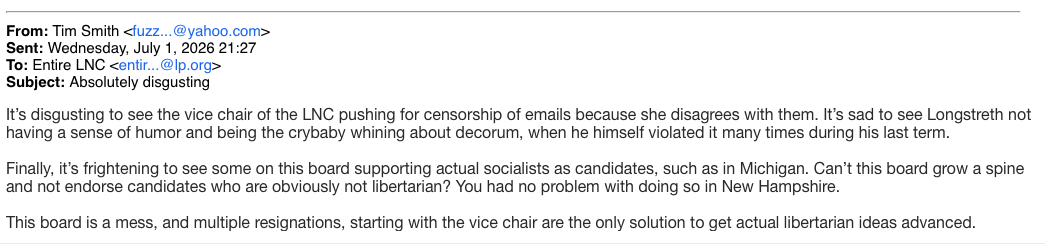
Griffiths responded by clarifying that the amendment addressed repeated genuine spam rather than disagreement with content. Region 8 Alternate Rose Leatherman, Griffiths' co-podcaster on LP Alliance, also engaged, explaining the context of the proposal. Martin forwarded the thread to the public list and nominated the exchange for an informal "Best LNC Contact of the Week" award. Further replies highlighted ongoing frustrations over decorum, accountability, and ideological consistency.
The record speaks
A point of order was raised over expression and sustained by the Chair, resulting in an instruction to an elected member to cease speaking on official channels, with no meeting and no vote. At the very same moment, affiliates across the country are formally demanding the party protect such expression.
Readers can judge for themselves what to call it. What cannot be disputed is that it happened, that it happened outside of any deliberative process, and that it happened to a member whose views run against the majority's. A party that describes itself as the home of the individual, the smallest minority on earth, now has a documented instance of its national leadership instructing one of its own elected representatives to be quiet.
The affiliates have seen it clearly enough to legislate against it. The autonomy and free expression of state affiliates are a major part of what makes us libertarians. Without it, we become beholden to the LNC for every bit of messaging.
LNC News covers the governance and internal affairs of the Libertarian National Committee. Documentation for the events described in this article is available on the committee's public list.